
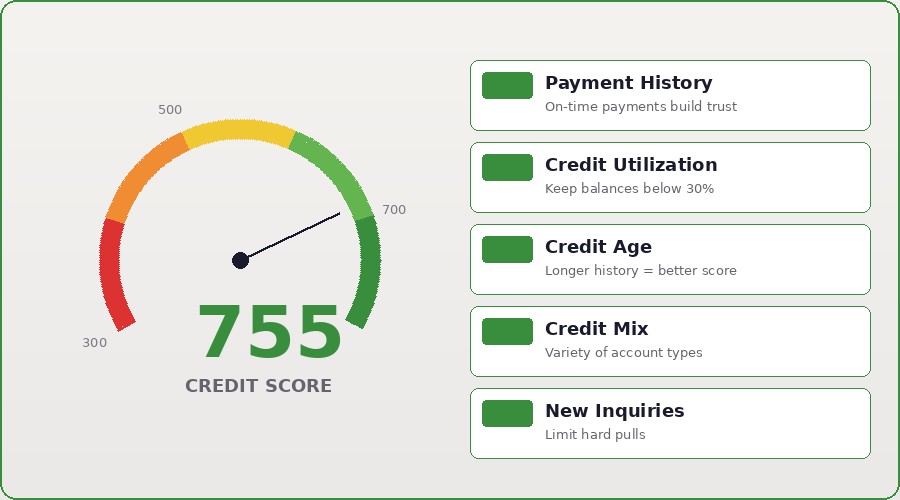
What Credit Utilization Actually Is
Credit utilization is the percentage of your available revolving credit that you're using right now. If you have a $10,000 limit across your credit cards and you're carrying $3,000 in balances, your utilization is 30%.
It matters more than most people realize. Utilization makes up about 30% of your FICO score — second only to payment history. That means it's one of the fastest levers you can pull to move your score, because unlike a late payment, high utilization isn't permanent. Pay the balance down and the score effect can show up within a single billing cycle.
Lenders read high utilization as a warning sign. Using most of your available credit suggests you may be stretched thin, even if you pay on time. Keeping balances low signals that you manage credit comfortably.
The 30% Rule — and Why Lower Is Better
You've probably heard you should keep utilization under 30%. That's a solid floor, but it's a ceiling you don't want to bump against. The truth is that lower is almost always better. People with the highest scores typically keep overall utilization in the single digits — often under 10%.
Think of 30% as the line where the damage starts to ease, not the target to aim for. Going from 70% down to 30% helps a lot. Going from 30% down to 9% squeezes out the last bit of available points.
One important nuance: credit bureaus usually see the balance reported on your statement closing date, not after you pay. So even if you pay in full every month, a high statement balance can still report as high utilization.
How to Lower Your Utilization Fast
Pay before the statement closes. Make a payment a few days before your statement closing date, not just before the due date. That lowers the balance the bureau actually sees.
Make a mid-cycle payment. If you use a card heavily, pay it down twice a month. This keeps the reported balance low without changing how much you spend.
Ask for a credit limit increase. A higher limit with the same spending instantly lowers your utilization ratio. Just don't treat the new room as money to spend.
Keep old cards open. Closing a card removes its limit from your total available credit, which can spike utilization overnight. Leave paid-off cards open.
Spread balances out. Carrying one card at 90% hurts more than spreading the same debt across two cards. Both your per-card and overall utilization are scored.
Per-Card vs. Overall Utilization
Scoring models look at two things: your overall utilization across all revolving accounts, and your utilization on each individual card. You can have a healthy 15% overall and still take a hit if one card is maxed out.
That's why a single card sitting at 95% can quietly hold your score down even when the rest of your credit looks great. If you're prioritizing, knock down the highest-utilization card first.
At 755CreditScore, we routinely see clients gain 20 to 40 points just by rebalancing how their existing debt is reported — no new payoff required, just smarter timing.
Common Mistakes That Quietly Raise It
Closing your oldest card to 'simplify.' It feels responsible, but it shrinks your available credit and can shorten your credit history.
Waiting for the due date to pay. By then your statement may have already reported a high balance.
Putting a large one-time purchase on a single card. Even if you'll pay it off, it can spike that card's utilization for the cycle it reports in.
Assuming paying in full means 0% reported. If the statement closed before you paid, the bureau may still see the full balance.
How 755CreditScore Helps
Utilization is one of the easiest factors to fix once you understand how it's measured — and it's often where we find quick wins for new clients. We review how each of your accounts reports, time your paydowns around statement dates, and build a plan that protects your score while you tackle larger goals.
If high balances are tangled up with collections, charge-offs, or reporting errors, we handle those under your rights through the FCRA and FDCPA at the same time.
Start with a free consultation. We'll look at your actual credit report and tell you exactly what we think we can move, and how fast.