
Why Checking Your Credit Report Matters
About 1 in 5 credit reports contain errors according to FTC studies — that's 40+ million Americans with wrong information on their credit reports. Errors range from incorrect balances to accounts that aren't yours to closed accounts listed as open. Your credit score is only as accurate as the information on your report, so checking it annually is non-negotiable.
Get free credit reports yearly from AnnualCreditReport.com (the only government-authorized free source). Check all three bureaus separately — Equifax, Experian, and TransUnion — because information varies. Look for incorrect accounts, wrong balances, inaccurate payment history, and accounts listed twice. Take detailed notes on any errors you find.
Once you spot an error, file a dispute in writing within 30 days of receiving your report. Send copies of documentation proving the error (account statements, payment receipts, proof of paid-off accounts). The bureau has 30 days to investigate and respond. Most bureaus process disputes faster now (10-15 days), but they're legally allowed 30 days.
Equifax, Experian, and TransUnion sometimes have different information because not all creditors report to all three bureaus. Your credit score with Equifax might be 680, with Experian 710, with TransUnion 695. This is why checking all three annually is important. If one bureau has an error the others don't, fix that bureau specifically.
How to Get Your Reports for Free
The DIY credit dispute process is straightforward but meticulous. First, get your free credit report from AnnualCreditReport.com. Second, identify inaccuracies — wrong balances, accounts that aren't yours, late payments you don't recognize. Third, write a dispute letter to the credit bureau with copies (never originals) of proof. Fourth, send certified mail with return receipt. Fifth, wait for their 30-day investigation.
What to dispute: accounts that aren't yours, wrong balances, late payments you don't recognize, accounts listed twice, closed accounts marked open. What not to dispute: accurate negative information (charge-offs, charge-off collections). Disputing accurate information wastes time — the bureau investigates, verifies it's accurate, and dismisses your dispute.
The proof you include matters. Dispute with documentation showing the creditor's error: bank statements proving you paid, letters from creditors confirming a payment, proof of payment from PayPal or bank transfers. Without documentation, the bureau will contact the creditor, they'll verify it's accurate, and your dispute is denied. Strong evidence gets faster, better results.
Sometimes DIY doesn't work — your dispute gets denied, or inaccuracies remain. This is when a credit repair professional becomes valuable. They know the system intimately, understand creditor-specific reporting quirks, and have relationships with bureau employees. A good credit repair professional handles cases DIY couldn't crack. But start with DIY first if you have the time and patience.
What to Look for on Your Report
Good credit repair isn't a single move — it's a comprehensive approach combining multiple strategies simultaneously. Check your reports for errors (dispute inaccuracies), reduce balances (payment history and utilization), become an authorized user on positive accounts (mix and age), stay current on all new payments (the most important factor), and wait for negative items to age (time heals credit wounds).
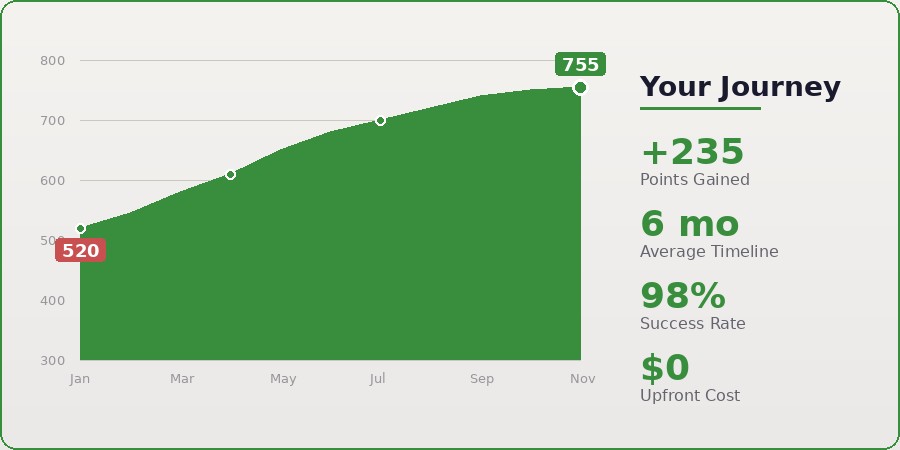
The timeline for visible results is 3-6 months if you're aggressive. If you dispute errors, you might see those removed in 30-90 days. If you pay down balances, your score improves within 1-2 billing cycles. If you get added as an authorized user, that score boost happens instantly. The compounding effect of multiple moves gives you 50-100 point improvements relatively quickly.
Realistic expectations: you can't remove accurate negative information, but you can dispute inaccurate items. You can't make old items disappear (but their impact fades over time). You can build a positive credit file starting today. Recovery from 450 credit to 700 credit typically takes 18-36 months with consistent action. It's not overnight, but it's absolutely achievable.
Work with credit professionals if DIY isn't moving the needle. Good credit repair companies combine dispute expertise, creditor negotiation skills, and strategic guidance. Legitimate companies charge ongoing fees (not upfront), give honest timelines, and focus on disputing inaccuracies and negotiating with creditors. The cost is worth it if it saves you months of effort and adds years to your credit recovery timeline.
Found an Error? Here's What to Do
Good credit repair isn't a single move — it's a comprehensive approach combining multiple strategies simultaneously. Check your reports for errors (dispute inaccuracies), reduce balances (payment history and utilization), become an authorized user on positive accounts (mix and age), stay current on all new payments (the most important factor), and wait for negative items to age (time heals credit wounds).
The timeline for visible results is 3-6 months if you're aggressive. If you dispute errors, you might see those removed in 30-90 days. If you pay down balances, your score improves within 1-2 billing cycles. If you get added as an authorized user, that score boost happens instantly. The compounding effect of multiple moves gives you 50-100 point improvements relatively quickly.
Realistic expectations: you can't remove accurate negative information, but you can dispute inaccurate items. You can't make old items disappear (but their impact fades over time). You can build a positive credit file starting today. Recovery from 450 credit to 700 credit typically takes 18-36 months with consistent action. It's not overnight, but it's absolutely achievable.
Work with credit professionals if DIY isn't moving the needle. Good credit repair companies combine dispute expertise, creditor negotiation skills, and strategic guidance. Legitimate companies charge ongoing fees (not upfront), give honest timelines, and focus on disputing inaccuracies and negotiating with creditors. The cost is worth it if it saves you months of effort and adds years to your credit recovery timeline.
Professional Credit Report Review from 755CreditScore
About 1 in 5 credit reports contain errors according to FTC studies — that's 40+ million Americans with wrong information on their credit reports. Errors range from incorrect balances to accounts that aren't yours to closed accounts listed as open. Your credit score is only as accurate as the information on your report, so checking it annually is non-negotiable.
Get free credit reports yearly from AnnualCreditReport.com (the only government-authorized free source). Check all three bureaus separately — Equifax, Experian, and TransUnion — because information varies. Look for incorrect accounts, wrong balances, inaccurate payment history, and accounts listed twice. Take detailed notes on any errors you find.
Once you spot an error, file a dispute in writing within 30 days of receiving your report. Send copies of documentation proving the error (account statements, payment receipts, proof of paid-off accounts). The bureau has 30 days to investigate and respond. Most bureaus process disputes faster now (10-15 days), but they're legally allowed 30 days.
Equifax, Experian, and TransUnion sometimes have different information because not all creditors report to all three bureaus. Your credit score with Equifax might be 680, with Experian 710, with TransUnion 695. This is why checking all three annually is important. If one bureau has an error the others don't, fix that bureau specifically.